This is not a synthesis of Gartner or McKinsey research. It is a synthesis of our own work. Over the last several engagements, we ran Operations Audits at six mid-market companies ranging from $30M to $500M in revenue, across six industries. We expected to find six different problems. What we actually found was three of them, repeated.
This piece walks through what we saw, what the pattern means if you're in the same revenue band, and the part of our findings that's harder to publish honestly (yet).
The six engagements
The shorthand we use internally:
| Engagement | Sector | Client shape | The friction we found first |
|---|---|---|---|
| PIPELINE-9 | SaaS, B2B sales | 80 AEs, 2-person RevOps, $85M ARR | Pricing logic distributed across 47 spreadsheets |
| SIGNAL-4 | SaaS, PLG | 3,000 accounts, 8 CSMs | Renewal risk surfaced 30 days late, after the moment to act |
| COUNSEL-7 | Legal, mid-size firm | 400-person firm, no in-house IT | Partners billing $500/hour doing contract triage |
| MERIDIAN | DTC e-commerce | $120M brand, 4-person ops, Shopify Plus | Every 2,500 orders required another ops hire |
| ATLAS-7 | Healthcare, multi-clinic | 47-clinic network, cloud EMR | Audit evidence scattered across 14 systems |
| BEACON-3 | Talent / recruiting | 200 roles/quarter, 3 recruiters, Greenhouse | 4 hours/day on resume screening, 8 email round-trips per interview |
Each entry is a composite of real engagements. Details have been generalized to protect client confidentiality, but the frictions and outcomes are real.
That table looks like six different problems. Re-read it and the pattern surfaces: spreadsheets-as-system, senior-time-as-triage-queue, detection-after-the-fact. Three frictions, six dresses.
Pattern 1 — Knowledge in spreadsheets is a maturity signal, not a tool choice
The fastest tell of a company that's outgrown a stage but hasn't done the next stage's operations work is this: the most operationally critical information lives in spreadsheets, owned by individuals.
PIPELINE-9 is the clearest case. Pricing logic — the thing that determined whether each $85M-ARR deal happened — was distributed across 47 spreadsheets, several of them owned by employees who had left. New AEs couldn't price a deal without three Slack messages and a guess. The friction wasn't that pricing was hard. It was that the company had grown past the point where one person's mental model could hold it, and had patched the gap with files instead of operations.
We saw a quieter version in MERIDIAN. The DTC brand's operational expertise — which warehouse handled which SKUs, which carrier's exception rate was creeping up, which promotion historically broke the picking floor — lived almost entirely in a four-person team's heads, propped up by a row-per-day spreadsheet that one person owned. Headcount was hired against this gap, not against demand. Every 2,500 orders, they had to hire another person to know things.
The version in COUNSEL-7 was the most expensive. Partner-only knowledge — which firms conflicted, which clients had hidden referral arrangements — meant that even routine contract triage absorbed the firm's most expensive hours. Spreadsheet sprawl wasn't the problem; the problem was that institutional knowledge had never been written down. Spreadsheets were the symptom of the underlying gap.
The repeating shape: when growing companies hit somewhere between $30M and $500M in revenue, institutional knowledge in spreadsheets and individual heads stops being a feature and starts being a ceiling. The fix is rarely a better spreadsheet. It is moving the knowledge into a system that can be queried, audited, and inherited.
Pattern 2 — Senior time gets absorbed by work that doesn't require it
The second pattern we saw almost every time: the most expensive people in the company doing work that did not require their expertise.
COUNSEL-7 made it visible because the billing rate was specific. Partners billing $500/hour were spending fourteen hours a week on contract triage and conflict checks — work that an associate, a paralegal, or an automated check could have done. Across a 400-person firm, that pattern moved through the senior bench and through the bottom line.
SIGNAL-4 looked different on the surface but was the same shape. Customer success managers were spending sixty percent of their effort on healthy accounts that did not need their attention. The visibility gap forced them to be reactive at the wrong end — at-risk accounts surfaced too late to intervene; healthy accounts got the energy. The CSM was the expensive role; the work absorbing it was hand-holding that did not require the role's experience.
PIPELINE-9: senior RevOps assembling deal pricing in real time, on every deal, from those 47 spreadsheets.
This is the pattern that the headcount conversation never resolves. The instinct, at the $30M–$500M stage, is to hire more of the expensive role. The diagnosis is "we don't have enough partners" or "we don't have enough CSMs." The diagnosis is almost always wrong. There are enough partners and enough CSMs; the wrong work is reaching their desks. Fixing the routing of work is almost always cheaper than scaling the role.
In our experience: the teams that win don't necessarily have better senior people. They have routing that protects senior people from work senior people shouldn't do.
Pattern 3 — Detection delay is what compounds
The third pattern was the most invisible to the teams running the operations: how late their data was.
SIGNAL-4's risk surfaced thirty days before renewal. That sounds early. It is not. By thirty days out, the customer has already had the meeting where they decided. The intervention window had closed before the data showed up. The cost wasn't the customer leaving; it was that the cost of saving them had moved from "a five-minute call" to "an exec relationship escalation."
ATLAS-7 was the version of this pattern that had a regulator attached. Audit evidence across 47 clinics lived in fourteen systems. Twice a year, three FTEs went into audit-prep mode and spent weeks reconstructing what had happened. The clinical work hadn't changed. The compliance posture hadn't changed. What had changed was that the evidence had decohered over time across systems, and reconstructing it cost more than producing it would have at the moment. Continuous compliance visibility didn't reduce the work of compliance — it moved that work upstream, where it cost a fraction.
MERIDIAN's version was capacity. Demand patterns shifted faster than the four-person ops team could see them. By the time the spreadsheet was updated, the floor was already swamped, and the fix was hiring against a problem that would have been routine if seen in real time.
The repeating shape: at this revenue stage, the cost isn't the problem itself. It's the delay between problem and detection. A small problem caught in real time costs ten percent of the same problem detected at the end of a reporting cycle.
This is the part of operations intelligence that doesn't sound like a category — it sounds like routing data to where it can produce an action while the action is still cheap.
The six-to-ten-week shipping pattern
The category narrative for operations work — automation initiatives, digital transformation — is measured in quarters. The pattern across these six engagements is measured in weeks.
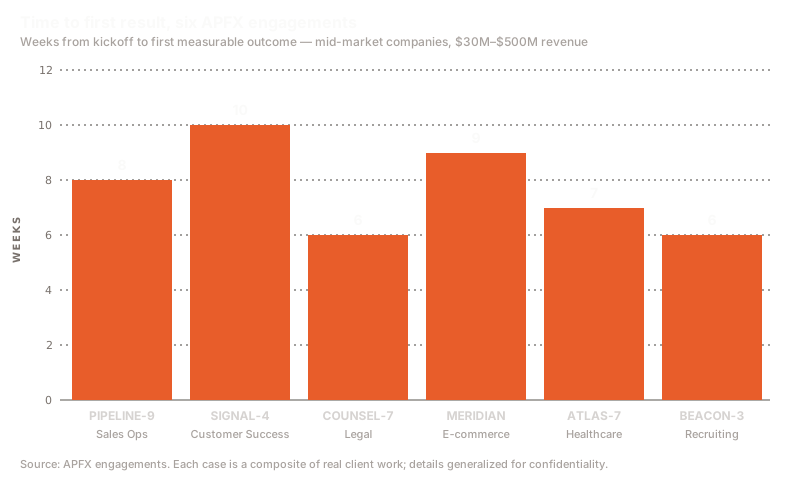
Six engagements, six results, six-to-ten weeks. The fastest were six weeks (COUNSEL-7's conflict-check streamlining; BEACON-3's recruiter-throughput build). The slowest were ten (SIGNAL-4's renewal-risk model — the most data-dependent of the six). The variance across the six is what gets fixed, not how long it takes to ship.
A few things made this possible, and they're worth naming because they aren't about technology choices:
- Scoped audits. Each engagement started with a one-week audit that produced an Impact Roadmap before anything was built. The variance got argued out at the diagnosis stage, not in the middle of a sprint.
- One core friction per phase. Each fix targeted one of the three patterns above. Not "modernize the stack." Pricing, or contract triage, or risk surfacing.
- The customer's people stayed in the loop. The team that owned the work participated in shaping the fix — which is why nobody worked around it after week three.
None of these are technology choices. They are operational ones. The technology underneath was specific to each case (Salesforce, Greenhouse, Shopify Plus, a custom risk model, an evidence-collection layer in a clinical compliance suite), and we will write each case study up separately. What stayed constant was the way the work was scoped.
What this means if you're at $30M–$500M
If you read those three patterns and recognized two of them, you are almost certainly leaving operating leverage on the table. The diagnostic that helps most is brutally simple:
- What knowledge runs the company that lives in a spreadsheet owned by one person? Make a list. The length of the list is the maturity signal.
- Which is the most expensive role in your company by hourly fully-loaded cost — and what fraction of that role's week is spent on work that role does not require? Honest answers are almost always 30%+ at this stage.
- For your three most consequential operational signals (revenue risk, capacity, compliance), how long is the gap between the problem starting and someone with authority knowing about it? Days is the minimum bar. Hours is what mature ops looks like.
The expensive misread is to take a yes on those three questions and reach for headcount. The pattern from these six engagements is that the leverage is in routing, visibility, and where knowledge lives — not in adding seats.
What we are not publishing yet
We were careful with the framing of this piece because we want it to be useful, not impressive. A few honest disclosures:
- Six is a small N. It is enough to call a pattern across six different industries, but not enough to call a benchmark. Our internal Operations Friction Benchmark is currently not at the threshold where aggregated statistics would be honest to publish. We will publish those when N >= 10 audits and the methodology rules in our reference data are met.
- These are composites. Each case is a generalization of one or more real engagements. We did this to protect client confidentiality. The frictions, durations, and primary metrics are real; specifics like AE counts and clinic counts are within the actual band but not exact.
- The pattern may not generalize past mid-market. Below $30M, the operations problems tend to be founder-attention problems; above $500M, they tend to be coordination problems. Different shape entirely.
We are also not generalizing this to "every mid-market company has these three problems." It is more accurate to say: when we have done the audit, the same three frictions are what we find more than anything else, in proportions that vary by industry but stay recognizable.
Where to go next
If you want the operator's version of these three patterns in standalone form, the Finding Friction cluster covers each individually. If you want the audit framework we use during week one, How to Run an Operations Audit in 5 Days describes it directly. And if your reading of the three questions above came back as more than one yes, the next move is to find the friction together — that is the work we do.
Next step
Ready to put tech to work?
Send a quick note. We’ll reply within one business day to explore where technology can drive the most value in your business.
Free Playbook
Know which AI plays to make.
The framework for finding the 2-3 AI workflows in your business that return 5-20x — and the ones that look obvious but quietly destroy margin.