Some companies run on gut feel. The ops leader who knows which team is the bottleneck, which process is about to break, which region is weak before anyone else notices.
That works, until the company outgrows one person's mental model. The friction goes dark. By the time problems surface, they've already cost you.
Operations intelligence replaces gut feel with data. It connects your ops systems, shows what actually happens in your workflows, and uses that information to drive faster decisions. For companies between $30M and $500M in revenue, this is often the difference between scaling smoothly and scaling into chaos.
Gartner defines operations intelligence as software that monitors, alerts, and supports decision-making using real-time ops data. The point: you see problems before you have to react, rather than after they've already hit.
What that definition doesn't capture is what it feels like inside a company that doesn't have it. In our work across mid-market operations teams, the pattern is consistent: friction goes dark before it gets loud. A team that loses 90 minutes every Monday to a workaround stops noticing it after eight weeks. Cross-departmental handoffs cost full price every time they trigger, but nobody owns them, so nobody flags them. Operations intelligence — the discipline, not the software — is the work of detecting these losses before they compound.
The market reflects this priority. The ops intelligence market was valued at $3.2 billion in 2024 and is projected to reach $6.8 billion by 2030, a 12% annual growth rate. Companies across industries have decided the cost of blind spots is unacceptable.
Why Operations Intelligence Matters at Scale
The Hidden Cost of Operational Blind Spots
Ops friction doesn't announce itself. A finance analyst spends 90 minutes every Monday pulling the same report from three systems. A sales rep emails four people to find out if a deal needs support. An ops team discovers a capacity problem two weeks after it started, because nobody was watching the right metrics.
None of these are crises. They're quiet, steady drains that compound across every team, every week, every quarter.
At the $30M to $500M stage, this pattern is particularly damaging. The company is large enough to generate real friction at scale but hasn't built systems to detect it. Decisions rely on gut feel. Problems bubble up instead of getting caught early. The senior team fights fires that a well-instrumented company would prevent.
The economics are concrete. McKinsey and other research finds that 20 to 30% of company capacity is lost to poor processes. Knowledge workers waste over 200 hours annually on rework. In manufacturing, unplanned downtime costs an average of $125,000 per hour for mid-market operations. Without visibility, you pay full price for every problem. With early detection, fixes cost a fraction as much.
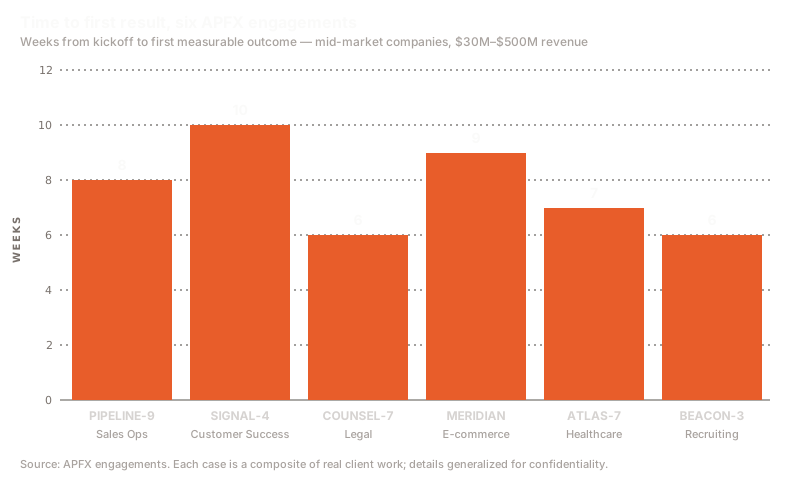
Our own engagements show how concentrated this work is once the right friction is named. Across six recent Operations Audits at companies between $30M and $500M revenue, the time from kickoff to first measurable outcome clustered in a six-to-ten-week range — not the year-long automation horizon the category narrative suggests. Recruiting throughput at one composite client tripled in six weeks; surprise customer churn at another fell 67% in ten. The lesson is not that every engagement looks the same, but that the variance is in what gets fixed, not in how long it takes.
The Visibility Gap
Most growing companies aren't losing time to one big, obvious problem. They're losing it to dozens of small ones that nobody has named: workflows that work well enough to avoid a hand-off, but slowly enough to bleed 15 hours a week out of the company.
How Real-Time Visibility Transforms Decision-Making
Batch reporting works on a calendar. Data is pulled, processed, and delivered on schedule, whether daily, weekly, or monthly. By the time you see the report, the moment to act has passed.
Real-time visibility operates on a different timeline. Data streams in from your CRM, ERP, support platform, and logistics tools, processed as it arrives. When something moves outside normal bounds, you know in minutes, not days.
The difference is stark. A customer success team with live ticket data catches a surge before it becomes a backlog. An ops leader watching live throughput detects a capacity issue before it delays a deal. A finance team with live revenue data doesn't wait until month-end to know if the quarter is on track.
Real-time data also changes where decisions get made. When information is current, the person closest to the problem can act, rather than waiting for a report cycle to authorize someone above them. Over months and quarters, that speed accumulates into a measurable competitive advantage. For a tighter framing of the same shift, see real-time vs retrospective operations monitoring and continuous improvement without burning out your team for the change-management side.
Core Operational Metrics Every Operations Leader Should Track
Cycle Time and Lead Time: Measuring Process Velocity
Cycle time and lead time are the base of process measurement. Both measure how fast work moves, but they track different things, and mixing them up gives you wrong answers.
Lead time is the total elapsed time from when work enters the system until it's done. A customer places an order Monday; it ships Thursday. Lead time: four days. It's the customer-facing measure of process speed.
Cycle time is the active time. It is how long work is actually being worked on, excluding wait time. If that order needs 45 minutes of actual handling on Thursday, cycle time is 45 minutes within a four-day lead time. The gap between the two is where friction lives: waiting for sign-off, queued behind other work, or sitting in a system nobody monitored.
For mid-market operations, tracking both metrics across core workflows surfaces improvement opportunities fast. High lead time with low cycle time signals a queue or handoff problem, not a capacity issue. High readings on both point to capacity or scope constraints. For sequencing the work that follows, see how to build an operations roadmap.
These metrics drive the most useful bottleneck analysis. With platforms like Microsoft Power BI or Tableau, ops teams can track them live across workflows and catch trends before they escalate.
Utilization Rate: Optimizing Resource Allocation
Utilization rate measures the share of available capacity actually spent on productive work. U.S. manufacturing utilization averaged 75.6% in late 2024, which was 2.6 percentage points below the historical average. In service operations, targets vary by function, but the principle is consistent: too low signals underuse, too high signals burnout risk.
The goal isn't maximum utilization. It's sustained utilization with enough buffer to handle unexpected load. A team running at 95% capacity has zero margin. When a customer issue, product problem, or supplier delay hits, the team doesn't slow down. It breaks.
Operations intelligence systems surface utilization trends across teams and time periods. You see which functions are running hot before they fail, which have room for additional work, and how utilization shifts with business cycles. That visibility leads to better staffing decisions, more accurate capacity planning, and fewer last-minute scrambles to foreseeable demand spikes.
Quality and Compliance Metrics: Early Detection Systems
Quality metrics track the rate at which outputs meet standards and, more importantly, reveal where they fail. A process step that produces rework-requiring outputs 15% of the time doesn't just slow that step. It cascades downstream costs that often exceed the original error.
Error rates, rework ratios, and first-pass yield are the core indicators. Each signals a different problem: high error rates point to unclear handoffs or missing input validation; high rework suggests vague acceptance criteria; low first-pass yield indicates missing quality checkpoints.
For regulated industries (financial services, healthcare, food production), compliance metrics work alongside quality metrics. Operations intelligence platforms monitor compliance checkpoints in real time, surfacing gaps as they occur rather than during quarterly audits. The difference between a real-time flag and one discovered months later is often the difference between a quick fix and a regulatory penalty.
Identifying Operational Bottlenecks
Understanding where operational friction lives is the first step. Operations intelligence makes that friction visible at all times, not just when someone flags a problem.
Manual Workflows as Hidden Friction Points
Manual workflows are the most common ops drag. They're also the hardest to see, because teams doing manual work have normalized it. They've built the spreadsheet, set up the weekly export, written the Monday email. It works. Nobody complains. The friction is invisible. For a deeper accounting of what those patches actually cost, see the hidden cost of manual workarounds.
To find it, ask direct questions: What do you do by hand that should be automated? What breaks if you take a three-day break? What report do you build weekly without asking whether it could build itself?
Those answers show where human effort is patching system gaps. The cost is real, in hours, in errors, and in attention pulled from higher-value work. Manual data re-entry between two systems is the most common case: it consumes time on both ends, introduces errors that automated transfers eliminate, and ties up people who should be analyzing, not typing. Automation fixes this at the source.
Legacy System Integration Challenges
Most growing companies eventually face a mismatch between their tools and their needs. The CRM was chosen when sales was five people. The ERP predates the company's expansion. The reporting stack was built by someone who left years ago. Each system functions independently. They don't integrate.
Legacy system integration problems rarely cause obvious failures. They create friction: extra manual steps to bridge gaps, conflicting metrics when systems track the same thing differently, and decision delays because required data stays trapped in unconnected systems.
ERP and CRM integration is particularly high-stakes. When Salesforce deal data doesn't automatically sync with ERP financial data, finance and sales operate from different numbers. This breeds revenue tracking errors, payment disputes, and decisions made on stale data.
Data Silos: The Communication Breakdown
Data silos are the organizational version of integration failures. Each department maintains its own data in its own systems, accessible only to its own team. When silos don't connect, one function makes decisions without context from another.
Sales commits to delivery dates without seeing live inventory. Marketing runs campaigns to customer segments with known satisfaction issues, unaware of support data. Finance can't model cash flow accurately without pipeline visibility.
Data silos are usually a technical problem (systems that don't connect), but the damage is organizational. Cross-functional decisions slow. Conflicts multiply. The ops leader ends up mediating disputes that shared data access would prevent.
Without Operations Intelligence
With Operations Intelligence
Real-Time Operations Intelligence in Action
Supply Chain Visibility: The Lenovo Case Study
Lenovo's scaling challenge was familiar: multiple data sources, constantly moving inventory, and response times measured in days while markets shifted in hours.
Working with IBM's Watson Supply Chain Insights, Lenovo rebuilt its incident tracking and response process across three use cases in five weeks. Supply chain incident response time dropped 95%. Problems that once took days to diagnose and reroute were handled in minutes. Analysis time fell 90%.
The difference wasn't faster analysts. It was real-time data replacing a manual process. Before, humans pulled data from multiple sources, reconciled gaps, and routed requests through approval chains before acting. Automating that pipeline moved decision authority to whoever could act immediately.
A problem seen in a weekly report has already accrued costs. A real-time alert lets you respond before costs accumulate. That's the entire case for supply chain visibility in four sentences.
Manufacturing Quality Control: Sapura's Equipment Monitoring
Sapura, an industrial engineering group, deployed real-time equipment monitoring across its offshore operations. The problem: unplanned equipment failures caused expensive downtime on offshore platforms, where repair costs far exceed onshore equivalents.
Sapura fit critical equipment with sensors that fed into a real-time monitoring system, tracking vibration patterns, temperature, and performance to predict failures before they occurred. The shift: from reactive to predictive maintenance.
The operational difference is significant. Maintenance teams work through a prioritized queue instead of fighting crises. Technician time shifts from emergency repairs to scheduled interventions. Downtime becomes planned and brief rather than chaotic and extended.
The same principle applies beyond offshore platforms. Any manufacturing operation where early detection improves economics (equipment, physical assets, batch processes) is a candidate. The enabling technology, IoT sensors feeding into platforms like Qlik Sense or Power BI, is now accessible to mid-market manufacturers.
Reducing Decision-Making Time from Days to Minutes
Lenovo's result illustrates a consistent pattern: operations intelligence compresses decision cycles by cutting steps between data and action.
Traditional batch reporting follows a predictable path. Data accumulates, gets pulled into a scheduled report, gets reviewed in a meeting, triggers discussion, and eventually produces a decision that reaches the people who can act. A week or more, in most organizations. Problems that needed a Monday response get addressed Friday.
Real-time ops intelligence collapses that cycle. Data is current. Alerts fire automatically. Dashboards route relevant information to the right person without waiting for a report to land. Decisions happen when they matter, not when the calendar allows.
Operational Analytics Platforms: Tools for Real-Time Monitoring
Dashboard and Alerting Fundamentals
A dashboard is only as useful as the decisions it enables. Most companies build too many of them and use too few. The common mistake: dashboards designed to display data rather than trigger action.
Good dashboards are built around questions, not metrics. What would make me act today? Which workflows are outside normal bounds? Which teams face capacity risk this week? Every metric on the screen should connect to a specific decision or alert. Metrics that don't connect to an action belong in a report, not a live dashboard. For a fuller treatment of this, see building an operations dashboard that actually gets used.
Alerting is where ops intelligence actually earns its keep. Set a threshold (throughput below X, error rate above Y, cycle time past Z). When breached, the right person gets notified immediately. No one needs to remember to check a slowly-moving metric. The system watches.
Microsoft Power BI, Tableau, and Qlik Sense dominate the mid-market operations intelligence space. Power BI holds an 8.9 customer rating on Gartner Peer Reviews. Tableau leads for flexible visualization. Qlik Sense wins when complex data modeling and rapid exploration are priorities.
Predictive Analytics for Demand and Inventory
Predictive analytics extends real-time visibility into the future. Real-time tells you what's happening now. Predictive tells you what's likely next, and that lead time gap is where the most valuable actions are.
Inventory management is the clearest example. A system that forecasts demand by SKU, region, and season lets buying teams purchase ahead of need instead of reacting to stockouts. Stockouts cost lost sales and customer trust. Excess inventory ties up cash and carrying capacity. Better demand modeling reduces both, not by predicting perfectly, but by tightening the error range enough to consistently improve buying decisions.
Workforce planning works the same way. A service company that forecasts volume four weeks ahead can staff with lead time. Without it, teams scramble to hire when demand has already surged. That is slower, more expensive, and disruptive to everyone already stretched thin.
AWS identifies demand forecasting as one of the highest-ROI uses of operations intelligence for growth companies. The technology is accessible at the $30M to $500M revenue level, and returns are measurable.
Choosing the Right Platform for Your Growth Stage
Enterprise tools no longer require enterprise budgets. But mid-market companies still make a common selection mistake: choosing based on what large enterprises use rather than what solves the actual problem.
A $50M company doesn't need a $2M data infrastructure. It needs three to five solid integrations between core systems, clean data flowing through them, and visibility into the metrics that drive key decisions. Most companies haven't fully used what Salesforce, HubSpot, or NetSuite already offer before adding specialized tools.
Match platform choice to use case. Appian suits companies blending process automation with ops monitoring. Power BI fits Microsoft ecosystem shops. Tableau wins where flexible visualization and user-driven exploration matter. Qlik Sense excels in data-heavy environments requiring rapid analysis across complex models.
Start with the right question: what decisions do we need to make faster, and what data do we need? The platform follows from the answer.
AI and Automation: The 2026 Perspective
Machine Learning for Anomaly Detection
Machine learning shifts ops monitoring from threshold-watching to pattern recognition. Traditional alerts fire when a metric crosses a preset boundary. ML anomaly detectors learn what normal looks like over time and flag deviations, including subtle ones that never breach a static threshold.
A gradual cycle time drift that stays just under a fixed limit might be a growing problem that traditional alerting misses entirely. An ML model that accounts for seasonality, day-of-week patterns, and historical variation will catch it. It's detecting drift against the expected baseline, not just a hard number.
The result is fewer false alarms and better coverage. Alerts fire when something genuinely unusual is happening, not just when someone manually-configured a threshold months ago.
Agentic Automation: Human-AI Operational Teams
The defining shift in 2026 ops management is agentic AI: systems that don't just surface data but take action within defined boundaries.
Today, a human reviews an anomaly alert and decides whether to act. With agentic systems, the AI reviews the same alert and, within its defined scope, routes the issue, initiates a pre-approved response, or escalates with context already assembled. Humans stay in the loop, approving decisions and handling exceptions, but at a higher level, not executing every step manually.
Seventy percent of banking institutions already run some form of agentic AI through deployments or active pilots (2025 Financial Brand research). The pattern isn't limited to banking. Any operation with high-volume, rules-based decisions (claims processing, order fulfillment, escalation routing) is a candidate.
When AI handles structured responses, ops teams focus on decisions that require judgment. At the $30M to $500M stage, that capacity gain matters most, because headcount isn't a scalable answer to volume growth.
Governance and Oversight in Automated Operations
Automation without governance creates risk. The more autonomously a system operates, the more important it is to define its boundaries up front: what it can do without approval, what triggers human review, what causes it to pause and escalate.
Operational governance for automated systems requires three things. Scope: which processes the system can act on and at what scale. Exception handling: what happens when the system encounters scenarios outside its defined limits. Audit trails: complete records of every automated action for review and compliance.
Companies that skip governance during deployment tend to pay for it later: errors made at scale before anyone reviewed them, or compliance gaps from unrecorded actions. Building this in from the start costs far less than adding it after something goes wrong.
From Insight to Action: Implementing Operations Intelligence
The Implementation Path
Building a Data-Driven Culture
Operations intelligence tools don't drive behavior change on their own. Teams need to actually use them. That's primarily a cultural question: whether the organization makes decisions from data or defaults to seniority, precedent, and intuition.
Signs of a data-driven culture are clear: decisions in meetings are supported by data, not decorated with it afterward. People ask "what does the data show?" before "what do you think?" When data contradicts a strongly-held belief, the data gets examined rather than dismissed.
Building that culture at the $30M to $500M stage comes down to leadership behavior. If the senior team runs on intuition and treats dashboards as props during reviews, the company follows. If senior leaders visibly use data in decisions and post-mortems, the behavior spreads. Tools enable it. But culture requires deliberate building.
Change Management and Adoption
Operations intelligence initiatives fail more often for organizational reasons than technical ones. The tools work. The data is clean. But teams don't change how they operate based on a dashboard. Metrics displayed don't align with how managers are evaluated. The dashboard sits unused in weekly meetings.
Strong change management starts before deployment. Involve the people whose work will change, not just in deciding what to build, but in designing how it works. Clarify who owns each metric. Define who acts when a threshold is breached. Map how new visibility fits into team meetings, executive reviews, and escalation processes.
Teams normalize friction over time and stop seeing it as a problem. Operations intelligence makes that friction visible again. That process is uncomfortable before it's useful. People don't love being shown inefficiency they've learned to live with. Managing that transition is a real part of the work.
Measuring ROI from Operational Intelligence Investments
Operations intelligence returns show up in three places. Understanding all three lets you build an internal case and track whether the investment is working.
Efficiency gains are the most direct. Time saved automating manual processes. Faster cycle times on core workflows. Lower error rates from data-entry steps. A four-hour-per-week workflow condensed to 15 minutes recovers 200+ hours annually. At $80/hour fully-loaded for an ops analyst, that's $16,000 per year from a single workflow. Most teams have dozens of equivalent opportunities.
Cost avoidance comes from catching problems before they escalate. Supply chain visibility prevents stockout expedite fees. Early detection of service issues reduces customer credits. Better data quality at the source eliminates downstream error-correction costs. These are harder to attribute directly, but they often represent the largest numbers in any honest ROI calculation.
Decision velocity is hardest to measure and frequently most important. Faster decisions enable faster execution. Deals close sooner, problems resolve before they compound, products ship on schedule. That speed, sustained over time, becomes a competitive gap.
Companies report 26% downtime reductions post-implementation. Seventy-nine percent cite output gains. Enterprise AI/OI builds return $3.70 per dollar invested on average, with top performers reaching $10.30.
Operations Intelligence Benchmarks for $30M to $500M Companies
Market Growth: 12% CAGR Through 2030
The core ops intelligence market grew from $3.2 billion in 2024 to a projected $6.8 billion by 2030, a 12% compound annual growth rate. Broader estimates including adjacent analytics and AI categories project a $25+ billion total addressable market. Across research firms, the core OI trajectory is consistent. For published medians by revenue tier, see operations benchmarks for $30M to $500M companies.
This growth reflects actual demand, not category enthusiasm. As companies scale, operational data volume outpaces what manual and batch-reporting processes can handle. Operations intelligence solves that bottleneck.
Adoption Trends: Financial Services and Beyond
Financial services leads adoption: 70% of banking firms run agentic AI through deployments or active pilots (2025). Financial operations are a natural fit: high-volume, rules-based, time-sensitive decisions are exactly what OI handles well.
Manufacturing, healthcare, and logistics are adopting fastest. Each shares a profile: high-volume operations with measurable outputs, significant failure costs, and existing data infrastructure ready for analytical layers.
The practical takeaway for mid-market companies: technology and implementation knowledge that was exclusive to financial services and manufacturing enterprises is now accessible without enterprise procurement timelines. Platforms that required six-figure builds years ago now deploy in weeks at SaaS pricing.
Cost Pressure: The Efficiency Opportunity
Global productivity loss from poor processes and disengagement exceeds $8.9 trillion annually (Gallup). No mid-market company can move that number. But the underlying dynamic is addressable at any scale.
For a $50M to $200M company, the efficiency opportunity lives in specific workflows, specific teams, specific processes. Bottlenecks are identifiable. Fixes are buildable. Results are trackable.
Operations intelligence doesn't change the nature of the problem. Friction has always existed. It changes how fast you find it, how precisely you diagnose it, and how quickly you can act. That speed is what you're buying.
Next Steps: Building Your Operations Intelligence Strategy
Assessing Current Operational Maturity
Start with an honest read of your current state. Ops maturity for $30M to $500M companies spans roughly five levels.
At the low end: operations run on email, spreadsheets, and institutional knowledge. Problems surface only after escalation. Reporting is assembled by hand. At the high end: real-time dashboards surface decision-critical metrics. Alerts fire before problems escalate. Automation handles structured tasks without human input.
Most mid-market companies sit somewhere in the middle: pockets of sophistication alongside manual chaos. Workflows function adequately but slowly, draining time every week. Assessment starts with one question: where does data flow cleanly, and where do humans fill the gaps?
A structured operations audit gives that question a formal structure. The five-day framework covers workflow mapping, bottleneck identification, and prioritization detailed enough to produce an actionable roadmap.
Prioritizing Friction Points for Elimination
Not all friction points are worth equal attention. Ranking requires two dimensions: impact (cost or time) and implementation difficulty.
High-impact, low-difficulty wins are the obvious starting point. A manual data transfer consuming six hours weekly but automatable via API integration. A report assembled by hand every Monday but easily scheduled and auto-distributed. These build internal confidence and generate the budget and political capital for harder work.
High-impact, difficult bottlenecks (legacy system integrations, cross-functional redesigns, multi-system reconciliation) belong on the roadmap after quick wins have proven the approach. Attempting them first, before the organization has seen results, is how operations intelligence initiatives stall before they deliver anything.
Roadmap: 90-Day Quick Wins vs. Strategic Initiatives
The first 90 days are about demonstrating value, not building infrastructure. Select one workflow that meets three criteria: painful enough that fixing it gets noticed, repetitive enough for sustained impact, and contained enough to deliver in weeks.
Fix it. Measure it. Report results in business terms: hours recovered, errors eliminated, decisions made faster. That result is the foundation for everything after.
The 90-day constraint also stress-tests your diagnosis. Bottlenecks that seem critical during an audit don't always deliver the most value once fixed. Real-world implementation reveals what analysis missed. A contained scope lets you learn without committing to a six-month build that turns out to solve the wrong problem.
Strategic initiatives (ERP integrations, cross-functional dashboards, predictive demand models) belong on a 12-month roadmap after quick wins have built both capability and organizational confidence.
Understanding common operational bottlenecks shortens the diagnostic phase. What feels unique to your company is usually a known problem with known solutions.
Operations intelligence isn't a transformation initiative. It makes visible friction you already know exists but haven't gotten to. Once it's visible, it's fixable. Once it's fixed, you get that time back.
Ready to identify where your operation is losing time and money? Let's map your friction together.
Next step
Ready to put tech to work?
Send a quick note. We’ll reply within one business day to explore where technology can drive the most value in your business.
Free Playbook
Know which AI plays to make.
The framework for finding the 2-3 AI workflows in your business that return 5-20x — and the ones that look obvious but quietly destroy margin.